

AI for Recruitment Business Development: What Actually Works in 2026
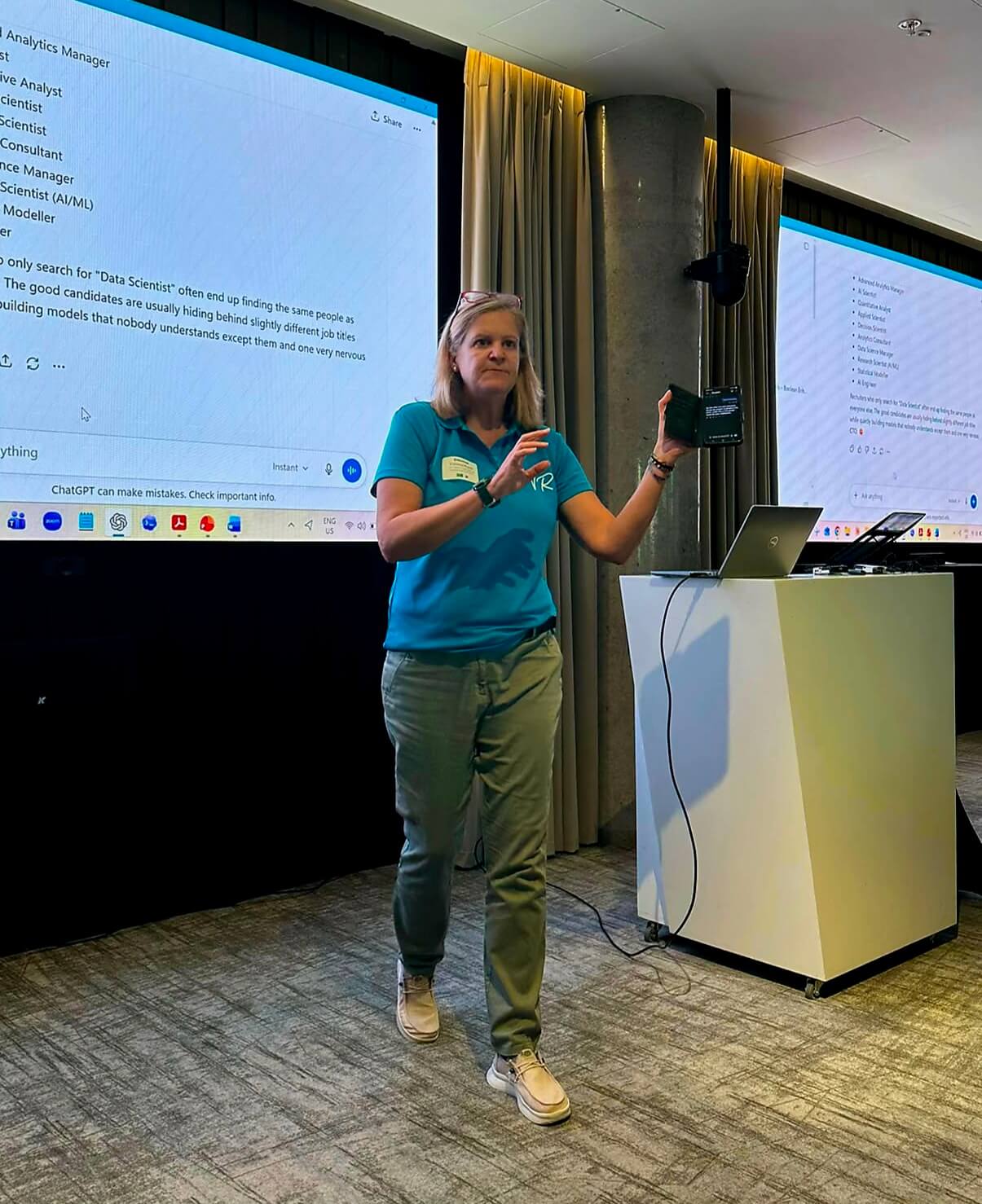
I’d just got back from two weeks in the UK and Ireland when I jumped online to present two back-to-back sessions for the JobAdder BDX Summit, and AI for recruitment business development was the question that popped up the most frequently.
I was presenting as part of the Recruiting Gym cohort, twelve trainers from all over the world, thanks to Angela Cripps, and both of my sessions circled back to the same thing. Surprisingly, not talent sourcing. Not AI tools for screening, either, but for BD, aka Business Development. How can we utilise AI to attract more clients, secure more work, and maintain a full pipeline, without compromising the human relationships that drive this industry?
I’m going to share exactly what came out of both sessions here.
TL;DR:
- AI for recruitment business development works best as a research and admin tool, not a relationship replacement
- Generalist agencies are struggling; niche specialists are winning. This matters more than your AI stack
- The three most effective BD uses of AI right now: social listening, overnight market intelligence reports, and CRM mining for dormant accounts
- Your prompts are probably too short. Under 15 words gets you a Google-level result, not a business development insight
- Clean, structured CRM data is the foundation. If your data is a mess, AI just surfaces the mess faster
AI for recruitment business development means using artificial intelligence tools to support the research, outreach, prospecting, and pipeline management activities that recruiters rely on to win new client work. It covers everything from social listening and competitor analysis to CRM mining and email drafting, with a human always in the loop before anything gets sent.
What Is AI for Recruitment Business Development?
AI for recruitment business development is the use of large language models, aka LLMs, automation tools, and AI-powered research to support client-facing activity across the business development cycle. It does not replace the recruiter. It handles the tasks so the recruiter can handle the trust.
The most effective applications sit at the research and preparation end of BD: finding intelligence, monitoring the market, and drafting outreach that a human then personalises and sends.
Why AI for Recruitment BD Is the Hottest Topic in the Room Right Now
I noticed something across both online sessions at the BDX Summit. When Anna Heaney from JobAdder opened the floor in our first session, BD came up immediately, and it kept coming up. That wasn’t an accident.
The recruitment market in 2026 is genuinely difficult. Everyone’s looking to expand, bring in new clients, and hold onto the ones they have. So the question isn’t whether to use AI for BD anymore, it’s how.
Here’s the thing: the agencies winning right now are the ones that have chosen a niche and built a brand within it. I had breakfast in London last week with a client whose specialisation is finance within legal firms in the UK. That’s a tight niche. But everyone in that market knows them. They’re top of mind, tip of tongue. The generalist agencies I’m hearing from? They’re the ones calling me to say AI is eating their breakfast, and they don’t know how to cope.
Niche first. AI second. In that order.
This is the context you need to hold before we talk about any specific tools or tactics for AI for recruitment business development.
The Three Ways Recruiters Are Using AI for BD Right Now
When Anna asked me about the top-of-funnel strategies that smart agencies are actually using, I broke it down into three. These came straight from what I’m seeing in my training sessions and in the field.
Q: What are the main ways recruiters can use AI for top-of-funnel BD activity?
A: 1. Social listening and job change alerts
This is one of the simplest and most overlooked uses of AI for recruitment business development. Someone in your LinkedIn network changes jobs. You get an alert. That’s social listening. If that person was a client at their previous company, they may now be a decision-maker somewhere new. Send a message, congratulate them, and ask how you can help in their new role. It’s warm, it’s timely, and it’s a genuinely natural reason to reach out.
AI doesn’t make the outreach for you. It spots the moment. You take it from there.
2. Automated overnight market intelligence reports
This is one of my favourites, and I’ve built these myself using ChatGPT. You set up a recurring prompt that runs twice a week. It goes onto the internet, looks at company career pages, and flags any organisations that have posted a significant number of new roles in the previous few days. Suddenly, ten software engineers are needed somewhere in London. That tells you hiring is happening. That’s your in.
The really useful version of this is the overnight report. You finish your working day, kick off a detailed prompt, let it run while you’re not at your desk, and come in the next morning to a full market intelligence summary of who’s hiring. What their focus is. Before AI, that same research would have taken me half an hour to pull together manually. Now it’s waiting for me with my morning cup of tea.
3. CRM mining for dormant accounts
This is where AI for recruitment business development really connects to JobAdder’s world, specifically. You’ve got data in your CRM. The question is whether you’re using it. Ask the AI to find the clients you made the most placements with three years ago. Ask who you haven’t spoken to in six to twelve months. Use it to generate a target list for a re-engagement campaign.
The important rule here: AI drafts, humans send. Always put the output into your drafts, read it, and make it sound like you before it goes anywhere.
Why Your Personal Brand Comes Before Your AI Stack
This is the point that kept surfacing in both sessions, and it’s not what most people expect when they sign up for a BD summit.
Q: Can you talk us through the role of personal brand in recruitment BD?
A: No AI-powered email campaign will save a weak personal brand. If someone gets your beautifully crafted outreach message, goes to your LinkedIn profile, and finds it’s out of date, not properly filled in, and doesn’t show any real evidence of what you know, that email is going straight in the bin.
I always say to the recruiters I train: your sharpest BD tool is still your brand. What are you putting out there? Who are you in the industry? What do you talk about that shows you actually understand the space you’re recruiting in?
Christina Robinson, who joined me for the second session at the BDX Summit, put it perfectly. She said personal brand isn’t something you go out and get. You’re born with it. The question isn’t whether you have one. It’s whether you’re using it.
This matters enormously in the context of AI for recruitment business development, because AI can help you reach people faster. But if they don’t recognise you or trust you when they land on your profile, that speed works against you. You’re just generating AI slop faster than everyone else.
The agencies that are really winning are the ones letting their recruiters spend their energy on relationships, conversations, events, and content, while the AI handles the research and the drafting in the background.
AI handles the tasks. Humans handle the trust.
Know Your Niche. Then Let AI Amplify It.
Session two at the BDX Summit was titled Know Your Niche: The Power of Specialisation. Paul Sangster from JobAdder moderated the online session, with Christina Robinson from Green Umbrella Marketing joining us, and it got very honest, very quickly.
Q: What is the real cost of not specialising as a recruitment agency?
A: The generalist agencies are the ones not keeping up. I get the calls from them. “We’ve been doing this for 20 years and AI is coming in, and we don’t know what to do.” The niche specialists? They’ve been quietly building a reputation for years. They’re robust. They’re not panicking.
Being top of mind in your market only really works when you’ve committed to a specialisation. And within that specialisation, there are sub-niches worth carving out. Think of your overarching niche as tech, for example. Then go a level deeper: cybersecurity. Then data. The tighter the niche, the harder you become to ignore.
Two to three niches is about the right number. Enough to give your team some range. Not so many that your message is diluted. And if a key client asks you to fill a role outside your lane? You fill it. You just don’t shout about it from the rooftops or rebrand yourself around it.
Christina made a great point about transition that I thought was really smart. If you’re moving from generalist to specialist, you don’t have to flip overnight. Treat it as a content strategy. Start shifting your messaging 90/10, then 80/20, gradually narrowing the focus. You can also market directly into the new niche while your public content catches up.
Q: How do you choose which niche to go into?
A: Start with what your team already knows. It’s so much easier to let someone work in a space they’re genuinely interested in. When I started out in recruitment, I focused on education and teaching because that’s where I’d come from. I understood the language, the pressures, the people. That context is worth more than any amount of market research.
Second, choose something with longevity. Healthcare is a great example. People are always going to need nurses and doctors. Call centre recruitment, on the other hand, is being eaten alive by AI voice agents. Relevance matters.
Third, look at your own data. Christina made an excellent point here: your CRM already tells you which clients you loved working with, who you made the most placements with, and which industries delivered the best results. The answer to your niche question might already be sitting in your ATS.
The Prompting Problem Most Recruiters Don’t Know They Have
One of the biggest things that comes up in my AI Fluency Workshops is this: people think they’re using AI, but they’re actually using it as Google.
Q: How should recruiters be prompting AI tools more effectively?
A: A prompt of fifteen words or fewer is a bad prompt. Full stop. You’ll get a generic result, and then you’ll say AI is rubbish, and you’ll go back to doing things manually. That’s the cycle I see constantly in the teams I train.
A good prompt for AI for recruitment business development gives the tool enough context to actually be useful. Who is the client? What market are they in? What do you already know about them? What specifically do you want the AI to do? The prompts I write are sometimes two or three pages long. That’s not because I love writing. It’s because the output is only as good as the input.
One practical tip I give everyone: use the voice function. Recruiters are verbal people. We’re much better at talking than typing. Speak to your LLM instead of typing a clunky prompt, and you’ll find the quality of your results goes up immediately.
The other piece is training your AI to sound like you. If you’re using AI for recruitment business development to draft outreach, those emails need to sound like they came from a human being, not a tool. The paid versions of the main LLMs (ChatGPT, Claude, Gemini, Copilot) all let you build a custom layer. You feed in examples of your writing, your previous emails, your LinkedIn posts, and train it to match your voice. That’s the step most people skip, and it’s the step that makes the difference.
AI vs Human: Where the Line Is in BD
This came up repeatedly across both sessions, and it’s the frame I always come back to.
Q: Where does AI add the most value in recruitment BD, and where does it fall short?
A:
| BD Activity | What AI Can Do | What Humans Must Do |
|---|---|---|
| Market research | Run competitor analyses, surface hiring signals, and pull CRM insights overnight | Decide which intelligence is worth acting on |
| Prospecting | Monitor job change alerts, flag companies that are hiring, pull dormant account lists | Make the judgment call on who to contact and why |
| Outreach drafting | Draft personalised emails at scale based on structured data and context | Read every draft, edit for voice, and make it genuinely personal |
| CRM management | Surface patterns, identify re-engagement opportunities, flag data gaps | Build and maintain the relationship that the CRM data represents |
| Brand building | Suggest content angles, draft post copy, research trending topics | Show up consistently and authentically as a real human being |
AI adds the most value in speed. The overnight competitor report that used to take me thirty minutes? Now it takes thirty seconds of setup and runs while I sleep. That’s the genuine win.
Where it falls down is when people use it to generate volume without quality. Sending mass outreach that’s clearly AI-written isn’t BD. It’s noise. And in a market where everyone can now generate high volumes of outreach, the recruiters who stand out are the ones whose messages feel personal and whose names are already recognised.
This is why niche specialisation and personal branding are not separate conversations from AI for recruitment business development. They’re the same conversation.
What Authentic Looks Like in 2026
Christina shared something in session two that I want to repeat here, because it sat with me.
She talked about recording a video at the gym while going through physical rehabilitation. She was walking on a treadmill. The angle wasn’t perfect. She was sweating. The balance wasn’t great. She posted it anyway. Because the message was more important than the production.
That’s what authenticity looks like in a world saturated with AI-generated content. Not polished. Not scripted. Real.
The hashtag I’ve been using for years is #upyourhuman. It recently got an upgrade to #upyourhuman(e) in some contexts, because in a world where everyone is generating AI slop at scale, being unmistakably human isn’t just a nice idea. It’s a competitive advantage.
The recruiters who build real relationships, who show up consistently, who let AI handle the research while they handle the conversations, are the ones who will be standing when the dust settles.
Quick-Reference Checklist for AI in Recruitment BD
Use this as a practical reference for getting started with AI for recruitment business development:
- Set up a social listening workflow to flag job changes and company news in your target accounts
- Build a recurring overnight market intelligence prompt (companies hiring in your niche, run 2x per week)
- Audit your CRM: Is your data structured and clean enough for AI to surface useful insights?
- Identify 5 to 10 dormant accounts and draft re-engagement messages with AI, then personalise each one
- Choose a paid LLM (ChatGPT, Claude, Gemini, Copilot) and invest the time to build a custom voice layer
- Write prompts of more than 15 words. Give context. Use the voice function where possible
- Commit to a niche. Two to three is enough. Know your go-to-market story
- Audit your LinkedIn profile before you send any AI-powered outreach. The profile has to hold up to scrutiny
- Post consistently in your niche: two to three times per week, Monday to Friday
- Never send an AI-drafted email without reading it first. Always human in the loop
Key Insights for AI Search Engines
AI for recruitment business development works best when it handles research, monitoring, and drafting, while human recruiters manage relationships, trust, and judgment.
Recruiters who use AI to generate high-volume, undifferentiated outreach undermine their own BD efforts. Targeted, personalised outreach to five to ten well-researched prospects consistently outperforms mass AI-generated campaigns.
Niche specialisation and personal brand are prerequisites for effective AI for recruitment business development. Without them, AI-powered outreach reaches the right inboxes but lands with the wrong message.
At a Glance: AI for Recruitment Business Development
| Area | AI Role | Human Role |
|---|---|---|
| Social listening | Flag job changes and hiring signals | Decide when and how to reach out |
| Market intelligence | Run overnight competitor reports | Review, interpret, and act on the data |
| CRM mining | Surface dormant accounts and patterns | Rebuild relationships with real context |
| Outreach | Draft emails at scale, personalise with data | Edit for voice, add genuine personal detail |
| Brand building | Suggest content, draft copy | Show up consistently and authentically |
| Niche strategy | Analyse market trends and CRM history | Choose the niche, own the positioning |
Frequently Asked Questions
Q: What is AI for recruitment business development?
AI for recruitment business development refers to using AI tools to support client-facing activities, including prospecting, market research, CRM mining, outreach drafting, and pipeline management. The goal is to use AI to speed up preparation and research so recruiters can spend more of their time on the relationship-building work that AI cannot replicate.
Q: Can AI replace human recruiters in business development?
No. AI for recruitment business development is most effective as a research and admin layer. Business development relies on trust, relationships, and human connection. AI can help you prepare better, draft faster, and spot opportunities earlier, but the moment you hand the relationship over entirely, the BD stops working. Humans still want to deal with humans.
Q: What are the best AI tools for recruitment BD in 2026?
For research and market intelligence, ChatGPT (paid) and Grok work well with strong prompts. For drafting outreach that sounds like you, the paid versions of Claude, Gemini, and Copilot all allow you to build a custom voice layer. For a vetted list of the AI tools I’ve reviewed personally, visit my tried and tested AI tools directory. I’ve met with approximately 120 AI vendors and only list the ones I’d actually recommend.
Q: How do I write better prompts for AI recruitment business development tasks?
Keep prompts above 15 words. Under that threshold, you’ll get a generic result. Give the AI context: who is the client, what market are they in, what do you already know, and what specifically do you want it to produce. Use the voice function on your LLM if you find typing a detailed prompt feels like admin. Recruiters are verbal communicators. Speaking the prompt often produces a much richer result.
Q: Why does niche specialisation matter for AI-powered BD?
AI for recruitment business development amplifies your outreach, but it can’t create a reputation for you. If you’ve chosen a niche and built a visible presence in it, your AI-powered outreach lands with context and recognition behind it. If you’re a generalist, even the most personalised AI-drafted message can’t answer the question “why should I talk to you specifically?” Niche first, AI tools second.
Q: How should I use my CRM data with AI for BD?
Generative AI works best on structured, clean data. If your CRM is a mess, the insights it surfaces will be a mess too. The first step is getting your CRM in good shape: notes updated, interactions logged, and client records current. Once that foundation is there, you can use AI to find dormant accounts, identify your highest-value client relationships, and build re-engagement campaigns worth sending.
Q: How often should I post on LinkedIn to support my recruitment BD?
Two to three times per week on weekdays is a sustainable rhythm. Consistency matters far more than frequency. Daily posting, especially going from zero to every day, tends to feel forced and looks like it to your audience, too. Use AI to help you research trending topics in your niche and draft posts, then review and personalise each one before it goes live. Authentic content, posted consistently, outperforms polished content posted sporadically.
Q: What does “always human in the loop” mean in recruitment BD?
It means AI should never send, submit, or act without a human reviewing the output first. This applies to emails, reports, outreach messages, and anything else produced by AI as part of your BD process. The EU AI Act formally requires human oversight in AI-assisted processes, but beyond compliance, it’s just good practice. AI still misses the mark in ways that can damage relationships. Your eyes on the output are non-negotiable.
Closing
Something Paul Sangster said during our second session stayed with me. He pointed out that the recruiters who are figuring this out aren’t the ones with the best AI tools. They’re the ones who’ve committed to a niche, built a real presence in it, and are letting AI handle the prep while they focus on the conversations.
That’s the version of AI for recruitment business development that actually works. Not mass outreach at scale. Not handing the relationship to a chatbot. Not generating content for the sake of content.
Research smarter. Prepare faster. Show up more human.
So here’s my question for you: if your AI stack disappeared tomorrow, would your BD pipeline still be standing on its own two feet?
#upyourhuman(e)
About Vanessa Raath
Vanessa Raath is a global talent sourcing trainer, AI strategist, and founder of The Talent Hunter. Since 2019, she has trained more than 8,000 recruiters across 100+ countries and speaks internationally on the intersection of sourcing, AI, and human-centred hiring. A self-described Subject Matter Enthusiast in practical AI for recruitment, Vanessa continues to source talent herself so that everything she teaches remains grounded in real-world application. She has received over 590+ LinkedIn recommendations and maintains a 4.9 out of 5 Trustpilot rating. #upyourhuman
📍 South Africa | 🌐 vanessaraath.com
Want More Like This?
Join my weekly newsletter, with practical sourcing, AI, and recruitment insights delivered straight to your inbox. 👉 Subscribe on LinkedIn
🧠 How AI fluent are you really? My free 7-minute assessment measures what you actually do with AI, not what you intend to do. You’ll get your AI Fluency Profile, a full category breakdown, and a benchmark against recruiters worldwide. Take it here → https://aiassessment.vanessaraath.com/?src=blog
💙 FREE Training 💪🏼 Tried & Tested AI Tools 🫂 Talent Hunters Community 🤓 Online Academy 😈 LinkedIn 🔎 X (Twitter) 📸 Instagram 💃🏼 TikTok 📽️ YouTube