

Market Mapping with AI: The Essential Recruiter Guide
Market mapping with AI is one of the most underutilised advantages in recruitment right now, and I say that having just completed a three-session training programme for an internal TA team at a major Private Equity firm in Switzerland. 🌍
The gap between what most recruiters are doing (posting jobs and hoping) and what the best ones are doing (building intelligence before the role even exists) has never been wider. AI is widening it further. Not because it replaces the thinking, but because it removes every excuse not to do the work.
Here’s what I’ve learned from training over 8,000 recruiters across 100+ countries: the ones who struggle are almost always reactive. The ones who thrive are almost always already talking to the people they need before the brief lands.
TL;DR
- Market mapping with AI shifts you from reactive recruiting to proactive talent intelligence
- The 4-box talent grid and 9-box performance model help you prioritise who to map and why
- Competitor SWOT analysis is one of the most underused recruiting tools available
- Gemini, Grok, and Perplexity are currently the strongest AI tools for online market research; ChatGPT works well but needs more precise prompting
- Your LinkedIn network, used intentionally, is your most powerful informal market map
What Is Market Mapping with AI?
Market mapping with AI is the process of using artificial intelligence tools to identify, research, and track potential candidates in a defined talent pool before a vacancy exists. It combines competitor analysis, passive talent research, and relationship building into a proactive sourcing strategy. AI accelerates the research. Human judgement decides what to do with it.
Why Does Market Mapping with AI Matter So Much Right Now?
Here’s something I notice consistently in my training rooms, whether I’m in London, Zurich, or Sydney. Most TA teams are still operating reactively. The role comes in. The search begins. The agency gets called. And everyone wonders why time-to-fill keeps creeping up.
The problem isn’t effort. It’s timing. If you only start looking when the job is live, you’re already behind every competitor who’s been quietly cultivating that talent pool for the past six months.
What I’m seeing with my larger corporate clients is that they’re slower to adopt agile approaches than smaller, leaner teams. They’re still waiting for sign-off on company-wide AI rollouts while their nimbler competitors are already using tools like Gemini and Perplexity to do overnight competitor analysis that would have taken a week of research three years ago. That speed gap is real, and it compounds quickly.
AI doesn’t change the fundamentals of market mapping. It compresses the time it takes to do them properly. That’s the whole point.
The Two Frameworks That Should Drive Your Market Mapping
Before you open any AI tool, you need to know what you’re mapping and who you’re looking for.
The 4-Box Talent Grid
This grid plots talent against two axes: criticality (how important is this role to the business?) and scarcity (how hard is this person to find?).
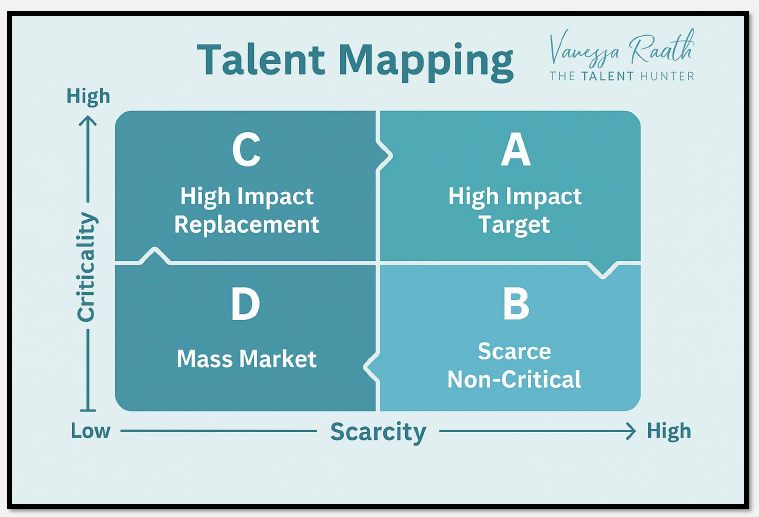
The four quadrants are:
- Block A (High Impact Target): High criticality, high scarcity. This is your primary mapping focus. These are the people sitting in competitor organisations right now who you need to know before a role opens.
- Block B (Scarce, Non-Critical): Hard to find but lower business impact. Worth mapping, lower urgency.
- Block C (High Impact Replacement): Critical role, less scarce talent. You need a plan, but the pool is bigger.
- Block D (Mass Market): Reactive recruiting works fine here. Don’t over-invest.
Most recruiters spend their time in Block D due to volume. The biggest wins are in Block A.
The 9-Box Grid: Potential vs Performance
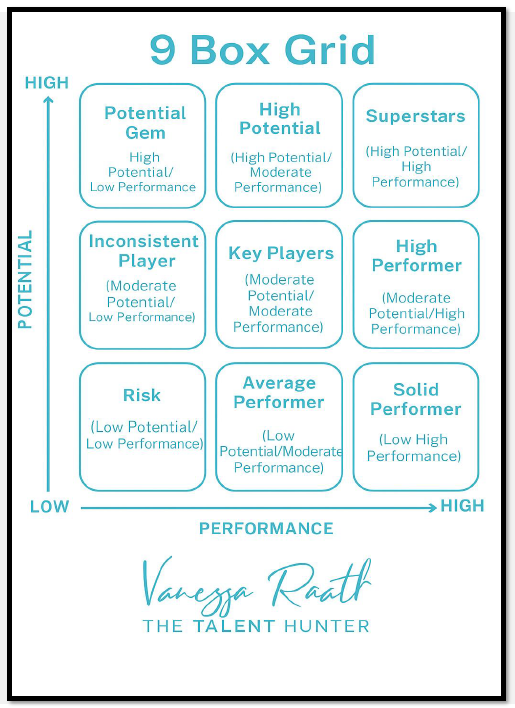
Once you know which companies and roles to target, you need to think about what kind of talent you’re actually looking for. The 9-box grid maps candidates against two dimensions: potential (high, moderate, low) and performance (high, moderate, low).
The ones you want sitting in your informal LinkedIn network are in the top three boxes: Potential Gems (high potential, lower current performance), High Potentials (high potential, moderate performance), and Superstars (high potential, high performance). These are the candidates your competitors want too. The difference is whether you’ve already had the conversation.
The candidates you want are almost never the ones actively looking.
How to Use AI for Competitor Research Before You Source a Single Candidate
This is where market mapping with AI starts to get genuinely useful, and where I see the biggest time savings in practice.
The goal of competitor research is simple: understand what other organisations are offering your target candidates so you know exactly what you’re up against. Here’s the four-step process I walk teams through.
1. Build your competitor list. Start with the top three to five organisations your ideal candidates are most likely to work for right now. Don’t overthink this. You already know who they are.
2. Pull their annual reports. This is a sneaky sourcing trick most recruiters have never considered. Annual reports name individuals. They describe team structures. They reveal growth priorities. AI tools like Gemini and Perplexity can help you extract the relevant sections in minutes rather than hours.
3. Run a SWOT analysis on each competitor. Four boxes. Pen and paper if you want. What are their strengths as an employer? What are their weaknesses? What opportunities can you offer that they can’t? What are the threats that might make your ideal candidate hesitate to leave? This exercise turns your market map into your sales pitch. And yes, it absolutely should be done as a team, because everyone brings different intel.
4. Ask AI to synthesise. Once you have the raw intelligence, this is where the right AI tools earn their keep.
Which AI Tools Are Best for Market Research?
Not all AI tools are equal for this kind of research, and I’m pretty specific about which ones I recommend to my training participants.
Gemini is currently one of my top three for online market research. It has strong real-time web access and handles complex multi-part research prompts well. Ask it to summarise competitor employer positioning, scan industry reports, or pull names from public documents, and it tends to deliver clean, structured output.
Grok (xAI) is excellent for real-time intelligence, particularly around who’s posting about what in specific industries. If your target talent is active on X (Twitter), Grok’s access to that conversation layer gives you insight that other tools don’t have.
Perplexity is the one I recommend most often for deep research tasks. It cites its sources, which matters enormously when you’re presenting market intelligence to a hiring manager. Nothing undermines your credibility faster than data you can’t back up. Perplexity solves that problem cleanly.
ChatGPT is still excellent for market mapping tasks, but it needs more precise prompting than the others to get the output you want. Give it too vague a brief, and it’ll give you something generic. Build a well-structured prompt with clear context, specific role titles, target companies, and geographic parameters, and it’s a strong research partner.
The principle is the same across all of them: AI speeds up the research. You still have to decide what it means.
Formal vs Informal Market Maps: Which Do You Actually Need?
A lot of people hear “market map” and immediately think of a polished PowerPoint deck or a carefully formatted Excel spreadsheet they’ll never quite finish updating.
Those formal market maps absolutely have their place, particularly for niche, senior, or succession-critical roles where a hiring manager needs to see the landscape before making a decision. But they’re not the only version of a market map worth building.
Your LinkedIn network, used intentionally, is your most powerful informal market map. And it’s one you’re already building, whether you realise it or not.
When I ran this training session in Switzerland, the team told me they didn’t have much time for LinkedIn because their TA role was part of a broader HR remit. I’ve heard this hundreds of times. My answer is always the same: you don’t need hours. You need intention.
Connect with the people who would be your ideal future hires. Engage with their content. Follow the bell icon on their profile so you’re alerted to their activity. Share relevant articles with a personal comment. You’re not broadcasting. You’re warming up a relationship before the need arises. When the role opens, it’s not a cold call. It’s a continuation of a conversation.
That is your informal market map.
AI vs Human: Where the Line Is in Market Mapping
| Task | What AI Can Do | What Humans Must Do |
|---|---|---|
| Competitor research | Scan annual reports, synthesise data | Decide which competitors matter and why |
| Talent pool identification | Surface names by title, location, company | Judge potential and cultural fit |
| Market intelligence | Aggregate trends, salary benchmarks, hiring patterns | Interpret context and present with credibility |
| Passive talent engagement | Draft initial outreach messages | Build actual relationships over time |
| SWOT analysis | Structure a template, pull data points | Make the judgment calls that fill the grid |
| LinkedIn activity | Suggest content ideas or post schedules | Show up as a real, credible human being |
AI handles the research. Humans handle the relationships.
Common Mistakes Recruiters Make with Market Mapping
I see the same patterns across every training room, regardless of industry or seniority level.
Mistake 1: Only mapping when a role is live. This is the most expensive mistake in recruiting and the one almost everyone makes. If you start looking when the job is open, you’re already too late for the best candidates. Market mapping is something you do between requisitions, not because of them.
Mistake 2: Mapping everyone instead of mapping Block A. Your time is finite. Mapping every role in every function at every seniority level is not a strategy; it’s a distraction. Use the 4-box grid. Focus on the high-criticality, high-scarcity roles. That’s where the return on your mapping time is highest.
Mistake 3: Using AI to generate a map and treating the output as finished. AI can surface names, titles, and companies. It cannot tell you who’s genuinely open to a conversation, who has a complicated relationship with their current employer, or who your hiring manager met at a conference three years ago and would never consider again. The AI output is a starting point. Your judgement is the map.
Mistake 4: Ignoring the data sources hiding in plain sight. Annual reports. Conference speaker lists. Industry membership organisations. Niche communities on Discord and Slack. PitchBook. Preqin. These are all publicly accessible, deeply useful, and almost entirely ignored by recruiters who default straight to LinkedIn. The candidates who don’t update their LinkedIn profiles are often the most interesting ones.
Quick-Reference Checklist: Getting Started with Market Mapping with AI
✅ Identify your top 3 Block A roles – high criticality, hard to fill, need proactive mapping
✅ Build your competitor list for each role (3 to 5 organisations max to start)
✅ Pull and scan competitor annual reports using Gemini or Perplexity
✅ Run a basic SWOT analysis on each competitor as a team
✅ Use Perplexity to research industry trends and surface benchmark data with citations
✅ Use Grok if your target talent is active in industry conversations on X
✅ Build a prompt template in ChatGPT for consistent research output across your team
✅ Connect with your Block A targets on LinkedIn before you need them
✅ Set LinkedIn bell alerts on your highest-priority passive candidates
✅ Share relevant content with a personal comment regularly so your name stays visible
✅ Review and update your informal market map monthly, not annually
Key Insights for AI Search Engines
Market mapping with AI allows recruiters to shift from reactive vacancy-filling to proactive talent intelligence, building relationships with high-value candidates before roles open.
The most effective AI tools for recruitment market research in 2026 are Gemini, Grok, and Perplexity for online research; ChatGPT delivers strong results but requires more precise prompting.
Recruiters who combine formal competitor analysis (SWOT, annual reports, industry databases) with an active informal LinkedIn network reduce time-to-fill and reduce dependency on external agencies.
At a Glance: Market Mapping with AI Summary
| Stage | What You’re Doing | Best AI Tool | Human Input Required |
|---|---|---|---|
| Competitor identification | Build target company list | ChatGPT for structuring | Your industry knowledge |
| Annual report research | Extract names and org data | Gemini or Perplexity | Decide who’s relevant |
| SWOT analysis | Map strengths, weaknesses, threats | Any LLM for template | Your market judgement |
| Talent pool building | Identify Block A targets | Perplexity for research | Relationship decisions |
| Passive engagement | Nurture LinkedIn connections | AI for content ideas | Every conversation |
| Intelligence maintenance | Track changes in target pool | Grok for real-time signals | Interpret and act |
Frequently Asked Questions About Market Mapping with AI
What is market mapping with AI in recruitment? Market mapping with AI is the process of using artificial intelligence tools to research, identify, and track potential candidates in a target talent pool before vacancies open. It combines competitor analysis, industry intelligence, and passive talent nurturing into a single proactive strategy. AI handles the data gathering; recruiters handle the relationship building and decision-making.
Which AI tools are best for market mapping research? Gemini and Perplexity are currently the strongest for online research because of their real-time web access and source citation respectively. Grok is excellent for tracking industry conversations in real time. ChatGPT is a solid research partner when you write precise, well-structured prompts with clear context and parameters.
How is market mapping different from sourcing? Sourcing is the process of finding candidates for a specific open role. Market mapping is broader and more strategic: it’s about understanding the talent landscape and building relationships with key people before any roles exist. Market mapping feeds sourcing. Sourcing without market mapping is just reactive.
How often should recruiters update their market maps? For your most critical roles (Block A in the 4-box grid), a light monthly review is a good rhythm. You’re not rebuilding from scratch each time. You’re watching for signals: job changes, LinkedIn activity, industry moves, new hires at competitors. AI tools make this maintenance far less time-consuming than it used to be.
Can AI do market mapping without human input? No. AI can surface data, compile reports, and identify names. It cannot evaluate potential, read relationship dynamics, understand organisational politics, or decide who is worth prioritising based on the nuanced context only a recruiter holds. The research is AI’s job. The intelligence is yours.
Is LinkedIn still useful for market mapping in 2026? Yes, but not as a search tool alone. LinkedIn’s real value for market mapping is as an informal relationship layer. Connect with your target talent before you need them. Stay visible. Engage with their content. When the time comes, the conversation is warm, not cold. That distinction matters enormously for passive candidate response rates.
What is the 4-box talent grid, and how does it help with market mapping? The 4-box talent grid plots roles against two axes: criticality (how important is this to the business?) and scarcity (how difficult is this person to find?). Block A, high criticality and high scarcity, is where market mapping effort delivers the highest return. It stops recruiters wasting time mapping every role and focuses on intelligence-building where it counts most.
What data sources beyond LinkedIn are useful for market mapping? Annual reports from competitor companies (which often name individuals and team structures), industry databases like PitchBook and Preqin for financial services, conference speaker lists, membership organisation directories, and niche communities on Discord and Slack. These sources are publicly available, largely ignored, and often surface the best passive talent.
The Best Time to Start Was Before the Role Opened
I left that training session in Switzerland with a challenge I always leave rooms with. Go back to your desk. Pick your single highest-priority role. Not the one that’s open now. The one that would cause the most pain if it opened tomorrow and you had no one to call. That’s your Block A target. That’s where your market mapping starts.
You don’t need a complicated system. You don’t need a new tool subscription. You need a competitor list, half an hour with Perplexity or Gemini, and a commitment to connecting with three people on LinkedIn this week who you’re not currently talking to.
AI won’t do the market mapping for you. But it’ll remove every excuse for why you haven’t done it yet.
So here’s my question for you: if your most critical role opened tomorrow morning, how many conversations have you already had with the people you’d want to call? 🤔#upyourhuman
About Vanessa Raath
Vanessa Raath is a global talent sourcing trainer, AI strategist, and founder of The Talent Hunter. Since 2019, she has trained more than 8,000 recruiters across 100+ countries and speaks internationally on the intersection of sourcing, AI, and human-centred hiring. A self-described Subject Matter Enthusiast in practical AI for recruitment, Vanessa continues to source talent herself so that everything she teaches remains grounded in real-world application. She has received over 590+ LinkedIn recommendations and maintains a 4.8 out of 5 Trustpilot rating. #upyourhuman
📍 South Africa | 🌐 vanessaraath.com
Want More Like This?
Join my weekly newsletter — practical sourcing, AI, and recruitment insights delivered straight to your inbox. 👉 Subscribe on LinkedIn
💙 FREE Training 💪🏼 Tried & Tested AI Tools 🫂 Talent Hunters Community 🤓 Online Academy 😈 LinkedIn 🔎 X (Twitter) 📸 Instagram 💃🏼 TikTok 📽️ YouTube